March 2, 2026
What Do AI Bosses Tell Their Kids to Study?
There's a scene quietly repeating itself across Silicon Valley.
Whenever Daniela Amodei, co-founder of Anthropic, wraps up a business meeting, someone will often linger at the door, a little sheepish, and ask her one more question:
"So… what should my kid study in college?"
Behind this question lies the anxiety shared by countless parents: AI is reshaping the job market at an unprecedented pace. By the time our kids graduate, what skills will actually matter?
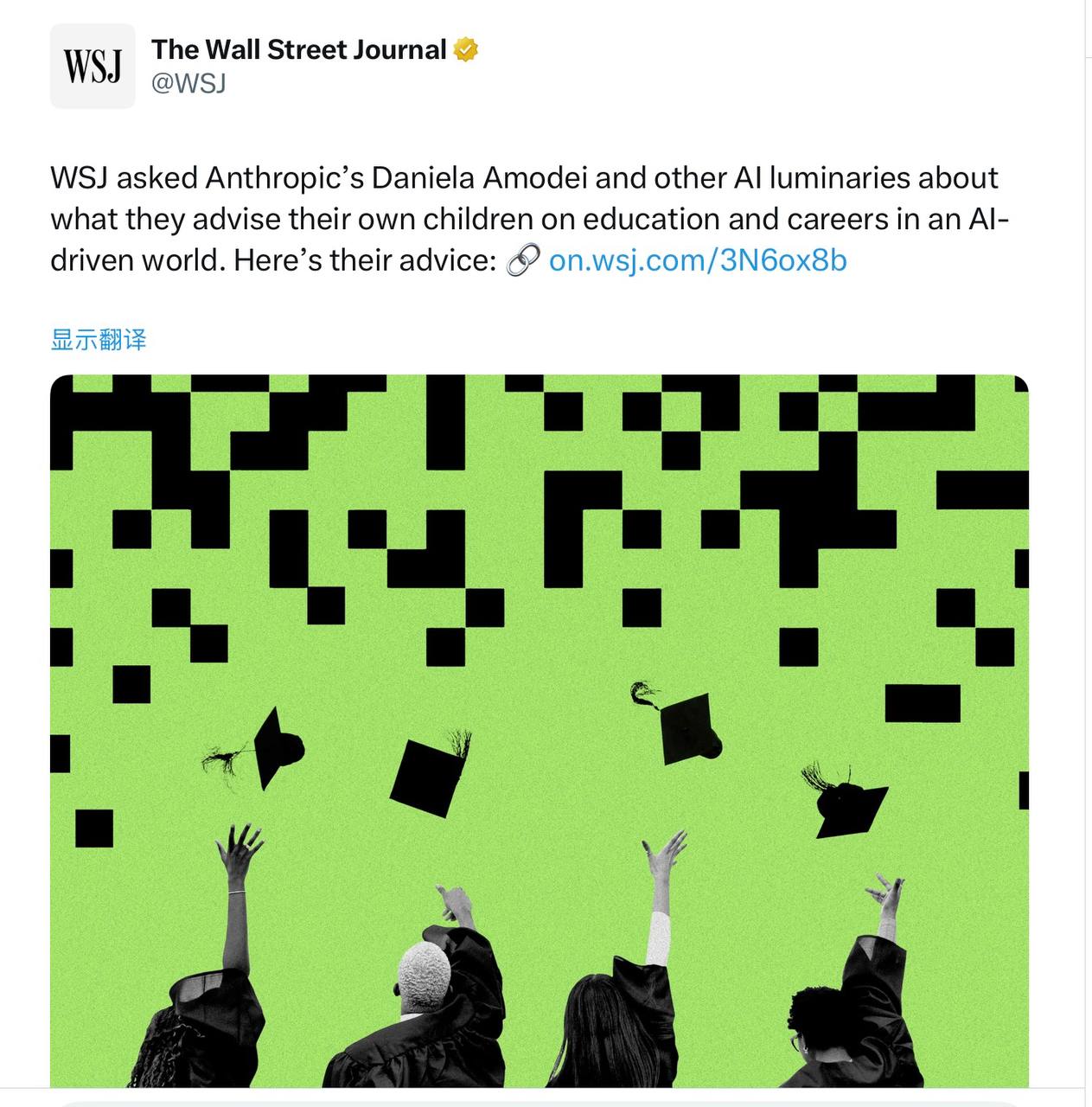
The Wall Street Journal recently put this very question to some of the most influential figures in the AI industry — asking what they personally advise their own children about education and careers.
Their answers might surprise you.
The Answer from Silicon Valley: Not Coding. Humanities.
Daniela Amodei, Co-founder & President, Anthropic
Daniela herself majored in literature at UC Santa Cruz. The co-founder of a company now valued in the hundreds of billions offered a counterintuitive answer drawn from her own experience:
"In a world where AI is very smart and capable of doing so many things, the things that make us human will become much more important — not less."
When she described what Anthropic looks for in new hires, the list had nothing to do with algorithms: great communication skills, high EQ, kindness, curiosity, and a genuine desire to help others.
On the value of the humanities specifically, she said:
"I actually think studying the humanities is going to be more important than ever. A lot of these models are very good at STEM. But understanding ourselves, understanding history, understanding what makes us tick — that will always be critically important. The ability to have critical thinking skills will be more important in the future, rather than less."
And she added: "At the end of the day, people still really like interacting with people."
Satya Nadella, CEO, Microsoft
The man running Microsoft pointed in the same direction — toward soft skills:
"As AI takes over more analytical and technical tasks, emotional intelligence and empathy are becoming increasingly important. IQ has a place, but it's not the only thing that's needed in the world."
Jamie Dimon, CEO, JPMorgan Chase
The head of the world's largest bank offered this advice to young people:
"Learn to write well. Learn how to perform well in a meeting. Get these soft skills right — you'll have plenty of jobs."
While AI will eliminate certain roles, Dimon argued that young people should lean into critical thinking and communication rather than doubling down on purely technical skills.
"Master Math and Science, Fear Nothing" — A Slogan Past Its Expiry Date
In China, generations were raised on a piece of folk wisdom: "Master math, physics, and chemistry, and you'll go anywhere in the world without fear."
This saying was born in the industrial age, when technical skills were scarce and knowing engineering meant leverage.
But that world is changing.
When AI can produce production-quality code, derive complex equations, and generate full reports in seconds, the scarcity premium on technical skills is eroding fast. What becomes truly scarce is what AI cannot replicate: judgment, empathy, values, creative thinking.
These are precisely what humanities education trains.
Zhang Xuefeng's Logic Doesn't Hold Up in the Age of AI
In China, a prominent college-application advisor named Zhang Xuefeng has become famous — or infamous — for telling students and parents: "If you can choose science, don't choose humanities." His argument: liberal arts majors have low barriers to entry, narrow job prospects, and poor salaries. He once talked a 590-point science student out of applying to journalism because, in his view, journalism had "no professional moat."
This logic had real-world grounding in the old job market. Zhang was essentially making probabilistic, volume-based recommendations to help ordinary families navigate an existing system.
But he failed to account for one variable: AI is fundamentally rewriting those probabilities.
As AI replaces swaths of standardized technical work — coding, data analysis, engineering calculations — the "professional moat" of technical skills is being demolished by the technology itself.
The abilities Zhang dismissed as moat-free — writing, communication, understanding human nature, critical thinking — are becoming the hardest-to-replace assets in the AI era.
To be fair, Zhang's advice isn't worthless for families who need to optimize for near-term employment. But if you extend the horizon to five or ten years out, using "employment rate" as the sole measure of a major's worth is a framework that has already aged out.
But This Isn't Your Old "Humanities" Class
One important clarification: the human skills that matter in the AI age are not what passes for "humanities education" in most Chinese high schools — rote memorization of dynasties, recitation of approved answers.
The capabilities Daniela Amodei described look like this:
- Critical thinking — the ability to independently analyze information without being led by whatever the AI spits out
- Empathy and emotional intelligence — genuinely understanding what people need, not just providing "correct" answers
- Communication and writing — the ability to make complex ideas clear; harder to replicate than writing code
- Curiosity and the capacity to keep learning — evolving through change rather than depending on fixed skills
These are built through reading, debate, expression, and lived experience — not through drilling exam questions.
For Chinese humanities education to truly have a renaissance, it needs a transformation of its own: from rote humanities to thinking humanities.
A Final Thought
AI is repricing human capability.
It is turning skills that can be standardized, quantified, and process-ified into commodities. And it is pushing the blurry, the emotional, the judgment-dependent skills toward a premium.
The age of "master STEM and go anywhere" isn't over — but it needs a sequel:
"Those who know how to think will be the ones who harness AI and go anywhere."
Sources: WSJ, "What AI Executives Tell Their Own Kids About the Jobs of the Future" (Feb. 26, 2026); Business Insider & Fortune interviews with Daniela Amodei; Microsoft CEO Satya Nadella; JPMorgan CEO Jamie Dimon